
Nepal's construction industry, a significant contributor to the nation's GDP, is undergoing a quiet but profound transformation. Traditionally reliant on manual processes and fragmented supply chains, the sector is now ripe for digital disruption. With increasing internet penetration and a burgeoning tech-savvy population, the adoption of technology in various industries across Nepal is on an upward trajectory. This presents a unique and timely opportunity for startups to innovate and introduce solutions that can streamline operations, enhance efficiency, and bring much-needed transparency to the construction material management landscape.
Nepal's Construction Landscape: Growth, Challenges, and the Need for Innovation
The construction industry in Nepal has consistently been a vital pillar of its economy. Recent data indicates a significant contribution to the national GDP, with figures averaging around NPR 131,962.61 million from 2010 to 2024, even reaching a high of NPR 167,143.79 million in 2021. Despite recent fluctuations, the sector has shown resilience, with a reported growth of 9.1 percent in the second quarter of the ongoing fiscal year, a significant rebound from 1.10 percent and 2.07 percent in the fiscal years 2022/23 and 2023/24 respectively. The government's allocation of NPR 380 billion for the construction sector in 2024 further underscores its importance.
However, this growth is not without its challenges. The industry often grapples with inefficiencies stemming from traditional practices. These include:
Fragmented Supply Chains: Lack of a centralized system for managing material procurement, leading to delays and increased costs.
Manual Processes: Reliance on paper-based systems for inventory, orders, and payments, which are prone to errors and slow down operations.
Lack of Transparency: Difficulty in tracking material movement, quality, and pricing, leading to potential disputes and mistrust among stakeholders.
Inefficient Logistics: Suboptimal planning for transportation and delivery of materials, resulting in wasted resources and project delays.
Limited Data Utilization: Absence of robust systems to collect and analyze data for informed decision-making and forecasting.
These challenges collectively highlight a pressing need for technological intervention, particularly in the realm of material management.
The Rise of Tech Adoption in Nepal: A Fertile Ground for Innovation
Nepal has witnessed a remarkable surge in digital connectivity and tech adoption over the past few years. Internet penetration has surpassed 75%, with reliable connectivity extending even to semi-urban areas. This widespread access to the internet, coupled with a growing number of smartphone users, has created a fertile ground for digital transformation across various sectors. While some reports suggest that industries in Nepal are still in the nascent stages of adopting advanced technologies like Industry 4.0, there is a clear and growing appetite for digital solutions that can enhance efficiency and productivity.
The Nepali startup ecosystem, though relatively young, is vibrant and rapidly expanding. Ranking 5th in South Asia and 107th globally, Nepal sees over 200 new startups emerging annually, contributing to a total of over 2,500 unique startups. These ventures are increasingly integrating technology into diverse sectors, including e-commerce, digital payments, and now, increasingly, the construction industry. The presence of companies like Basobaas, Nepal Property Bazaar, and Aarshav Technology within the Real Estate and Construction Tech space indicates a nascent but promising market for digital solutions in this domain.
Opportunities for Startups in Construction Material Management App Development
Given the challenges in the construction sector and the growing digital literacy in Nepal, startups have a significant opportunity to revolutionize construction material management. An app-based solution can address many pain points, offering benefits such as:
Enhanced Efficiency and Transparency: By digitizing order placement, tracking, and delivery, apps can eliminate manual errors, reduce delays, and provide real-time visibility into the supply chain. This transparency builds trust among all stakeholders—customers, suppliers (crushers), and transporters (drivers).
Optimized Logistics and Cost Savings: Features like dynamic tipper rate management, route optimization, and real-time tracking can lead to significant cost reductions in transportation and material handling. Predictive analytics, powered by data collected through the app, can further optimize inventory and procurement.
Improved Communication and Collaboration: A centralized platform facilitates seamless communication between all parties involved, from the construction site to the material supplier and the driver. This reduces miscommunication and ensures timely delivery.
Data-Driven Decision Making: The app can collect valuable data on material demand, supply patterns, delivery times, and payment trends. This data can be analyzed to identify bottlenecks, forecast demand, and make informed business decisions.
New Revenue Streams: Startups can explore various business models, including subscription-based services for premium features, transaction-based fees, or even offering value-added services like material quality assurance or financing options.
Scalability and Market Reach: A well-designed app can easily scale to accommodate a growing number of users and transactions, allowing startups to expand their reach across Nepal and potentially beyond.
Key features for such an app would include a comprehensive dashboard for administrators, robust order and product management, dynamic tipper rate setting, efficient user management for all stakeholders (customers, crushers, drivers), and streamlined payment processing. The inclusion of responsive design, dark/light theme support, global search, and export functionalities would further enhance user experience and utility.
The Future is Digital: A Call to Action for Nepali Startups
The digital transformation of Nepal's construction material management sector is not just an opportunity; it's an imperative. As the country continues its development trajectory, the demand for efficient and transparent construction processes will only grow. Startups that seize this moment to develop innovative, user-friendly, and robust material management applications stand to gain a significant competitive advantage.
By leveraging the increasing digital literacy and internet penetration in Nepal, and by addressing the specific pain points of the construction industry, tech entrepreneurs can build solutions that not only generate economic value but also contribute to the nation's infrastructure development. The time is now for Nepali startups to build smart, build efficiently, and build the future of construction material management.
Key Features and Modules of a Comprehensive Construction Material Management App
To effectively address the challenges and capitalize on the opportunities within Nepal's construction sector, a robust material management application should incorporate a comprehensive set of features and modules, catering to the diverse needs of its users:
For the Super Admin (Web Application):
Module 1: Dashboard (Overview)
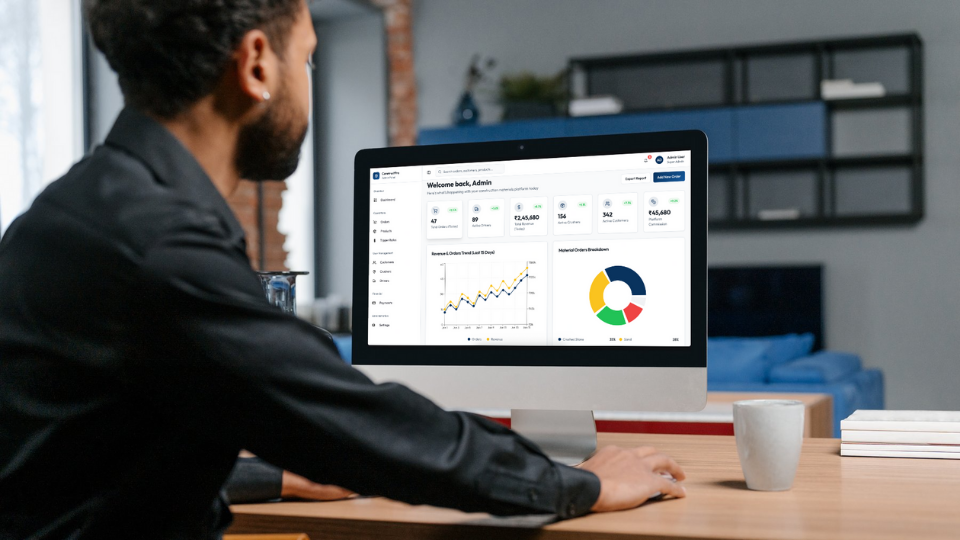
•Real-time Statistics Display: Key metrics like total orders, active drivers, revenue, and platform commission with percentage changes.
•Revenue Analytics Chart: Interactive line chart displaying revenue trends over time.
•Material Breakdown Chart: Visual breakdown of material types and quantities.
•Recent Orders Widget: Quick view of latest orders with status and basic details.
•Recent Activity Feed: Timeline of recent platform activities and updates.
•Today's Summary Widget: Quick stats for completed/pending orders and active customers.
•Quick Action Buttons: Fast access to add products, register customers, add drivers, and view analytics.
•Welcome Dashboard: Personalized admin welcome screen with export and add order capabilities.
Module 2: Order Management
•Order Listing & Search: Comprehensive table with search by Order ID, customer, crusher, or material.
•Advanced Filtering: Filter orders by status (pending, processing, in transit, delivered, cancelled).
•Order Details View: Detailed modal showing complete order information, customer details, and payment status.
•Status Management: Visual status badges and order tracking capabilities.
•Export Functionality: Export order data for reporting and analysis.
•Real-time Order Tracking: Live updates on order status and driver assignments.
Module 3: Product Management
•Material Catalog Management: Add, edit, and manage construction materials with specifications.
•Material Form Interface: Detailed forms for material properties including category, price, and specifications.
•Crusher Product Management: Specialized interface for managing crusher-specific product offerings.
•Stock Management: Track material inventory across multiple suppliers.
•Category-based Filtering: Filter materials by aggregate, sand, ready mix, base, and sub-base categories.
•Supplier Integration: Manage multiple suppliers for each material type.
•Price Management: Set and update material prices across the platform.
Module 4: Tipper Rate Management
•Dynamic Rate Setting: Configure base fares and per-kilometer rates for different tipper capacities (5, 8, 15 ton).
•Rate History Tracking: Visual charts and tables showing historical rate changes.
•Zone Management System: Create and manage delivery zones with custom rate multipliers.
•Real-time Rate Updates: Edit and save rate changes with immediate effect.
•Rate Analytics: Charts showing rate trends and comparisons across tipper types.
•Zone Coverage Mapping: Manage geographical coverage areas for different rate zones.
Module 5: User Management - Customers
•Customer Profile Management: Comprehensive customer database with contact details and order history.
•Registration System: Add new customers with complete business information.
•Activity Tracking: Monitor customer order patterns and spending history.
•Status Management: Activate/deactivate customer accounts.
•Search & Filter: Find customers by name, email, phone, or location.
•Customer Analytics: View total orders, spending, and engagement metrics.
Module 6: User Management - Crushers
•Crusher Supplier Database: Manage crusher businesses with location and contact information.
•Material Type Management: Associate crushers with their available material types.
•Performance Metrics: Track crusher ratings, total orders, and revenue.
•Status Monitoring: Monitor active/inactive crusher status and last activity.
•Geographic Mapping: Location-based crusher management and assignment.
•Revenue Tracking: Monitor crusher earnings and commission calculations.
Module 7: User Management - Drivers
•Driver Profile System: Complete driver information including license details and tipper specifications.
•Vehicle Management: Track tipper capacity, plate numbers, and vehicle details.
•Availability Status: Real-time driver status (available, on trip, offline).
•Performance Analytics: Monitor trip counts, earnings, and driver ratings.
•Assignment System: Driver-to-order assignment and management.
•Earnings Tracking: Detailed breakdown of driver earnings and trip history.
Module 8: Payment Management
•Transaction Monitoring: Comprehensive view of all financial transactions with filtering and search.
•Crusher Payout System: Automated calculation and processing of crusher payments with commission deduction.
•Driver Payout Management: Weekly/periodic driver payment processing with deductions.
•Financial Reporting: Generate detailed financial reports for different time periods.
•Commission Tracking: Monitor platform commission earnings from all transactions.
•Payment Status Management: Track payment statuses (completed, pending, processing, failed).
•Export Capabilities: Export financial data for accounting and tax purposes.
•Batch Processing: Process multiple driver payouts simultaneously.
Module 9: Platform Settings (Administration)
•Financial Configuration: Set platform commission rates and financial parameters.
•Notification Management: Configure email and SMS notification preferences.
•Operational Settings: Auto-assign drivers and set order timeout configurations.
•Company Information: Manage company details and support contact information.
•System Administration: Maintenance mode toggle and system-wide settings.
•Settings Reset: Restore all settings to default values.
•Real-time Updates: Immediate application of setting changes across the platform.
For Depo (Customers), Drivers, and Crushers (iOS and Android Mobile Apps):
These mobile applications will provide tailored functionalities for each user role, ensuring seamless interaction with the system for their specific needs. While the exact features will vary, they will focus on:
•Depo (Customers): Placing and tracking orders, managing delivery schedules, and viewing material details.
•Drivers: Receiving and managing trip assignments, updating delivery status, and tracking earnings.
•Crushers: Managing material availability, updating product offerings, and tracking payouts.
Additional System Features (Across all platforms):
•Responsive Design: Full tablet and desktop compatibility with a mobile-first approach.
•Dark/Light Theme Support: Consistent theming across all modules.
•Search Functionality: Global search capabilities across all data tables.
•Export Systems: PDF and Excel export options for all major data sets.
•Toast Notifications: Real-time success/error notifications for user actions.
•Data Validation: Form validation and error handling across all input forms.
•Navigation System: Collapsible sidebar with clear module organization.
•Loading States: Smooth loading indicators and skeleton screens.
•Security Features: Super admin role-based access control.
This comprehensive suite of features ensures an end-to-end solution for managing a construction materials platform, providing efficiency, transparency, and control across the entire supply chain.